Aurélie Féré

Superconducting junctions with flat bands

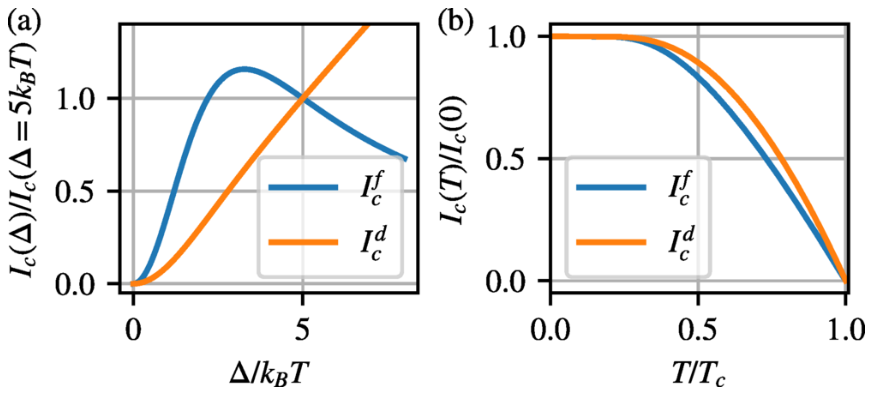
We analyze the properties of flat-band superconductor junctions that behave differently from ordinary junctions containing only metals with Fermi surfaces. In particular, we show how in the tunneling limit the critical Josephson current between flat-band superconductors is inversely proportional to the pair potential, how the quantum geometric contribution to the supercurrent appears even in the normal state of a flat-band weak link, and how Andreev reflection is strongly affected by the presence of bound states. Our results are relevant for analyzing the superconducting properties of junctions involving electronic systems with flat bands.

Superconducting junctions with flat bands Read More »

Revealing Electron–Electron Interactions in Graphene at Room Temperature with a Quantum Twisting Microscope

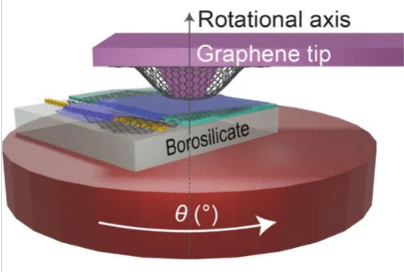
A quantum twisting microscope (QTM) enables energy- and momentum-resolved measurements of quantum phases through tunneling spectroscopy in twistable van der Waals heterostructures. Here, we improve its resolution and extend its range to higher energies and twist angles by integrating hexagonal boron nitride as a tunneling dielectric. This advance reveals previously inaccessible dispersion features in tunneling between two monolayer graphene sheets, consistent with a logarithmic correction to the linear Dirac spectrum arising from electron–electron interactions, with a fine-structure constant α ≈ 0.32 ± 0.01. Remarkably, these extremely subtle corrections are resolved even at room temperature. Our results highlight the exceptional sensitivity of the QTM, where interferometric interlayer tunneling amplifies small band-structure modifications. They further show that strong electron–electron interactions persist in symmetric, nonordered graphene states and demonstrate the QTM’s capability to probe spectral functions and excitations of correlated ground states across twisted and untwisted two-dimensional systems.

Revealing Electron–Electron Interactions in Graphene at Room Temperature with a Quantum Twisting Microscope Read More »

Proximity effects between a graphene quasicrystal and magic-angle twisted bilayer graphene

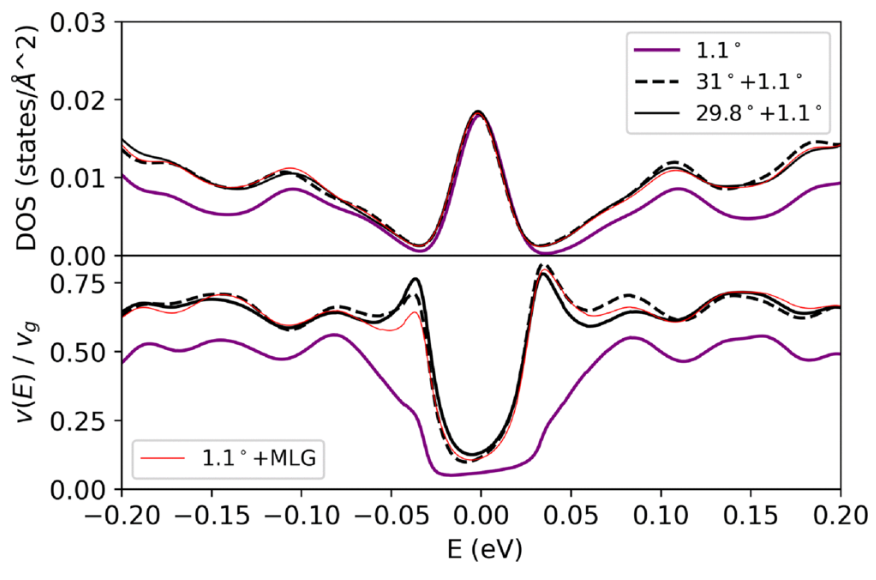
We present a numerical study of three-layer graphene heterostructures in which the layers are twisted by the magic angle (∼1.1∘) or by ∼30∘ to form a graphene quasicrystal. The heterostacks are described using realistic structural relaxations and tight-binding Hamiltonians, and their transport properties are computed for both pristine and disordered systems containing up to ∼8 million atoms. Owing to the weak interlayer coupling, we resolve the hybridization between magic-angle flat bands and quasicrystalline states, which are modified in distinct ways across low- and high-energy windows, revealing a different hybrid electronic regime to explore.

Proximity effects between a graphene quasicrystal and magic-angle twisted bilayer graphene Read More »

Our Project at Graphene2026 in Barcelona

We are pleased to announce that one of our project partners is actively involved in the organization of Graphene2026, the International Graphene Conference taking place in Barcelona from June 30 to July 3, 2026. Graphene2026 is one of the leading international events dedicated to graphene, 2D materials, and advanced nanotechnologies, bringing together researchers, industry leaders, and innovators from around the world. The conference will provide an important platform for scientific exchange, collaboration, and discussions on the latest developments in graphene-based technologies, including quantum applications, sensors, electronics, and advanced materials. More information about the conference is available on the official website:https://grapheneconf.com

Our Project at Graphene2026 in Barcelona Read More »

Phd student’s day at ucl

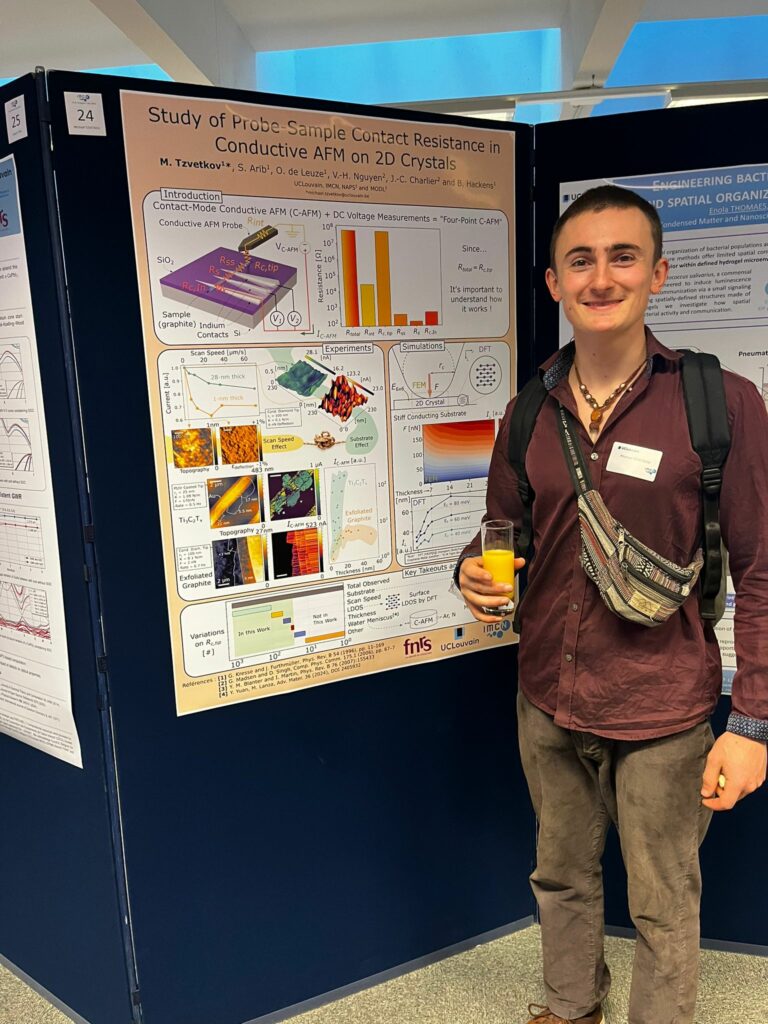
Michael Tzvetkov, a PhD student in the group of Benoît Hackens at UCL, presented a poster during the PhD Students’ Day on Friday 22nd of May 2026. His presentation showcased scanning probe measurements performed on graphene-based samples, highlighting both the experimental techniques and the rich electronic properties accessible in these systems. The poster generated fruitful discussions with students and researchers, illustrating the strong interest in nanoscale characterization of low-dimensional quantum materials.

Phd student’s day at ucl Read More »

Thermal transport mapping in twisted double bilayer graphene

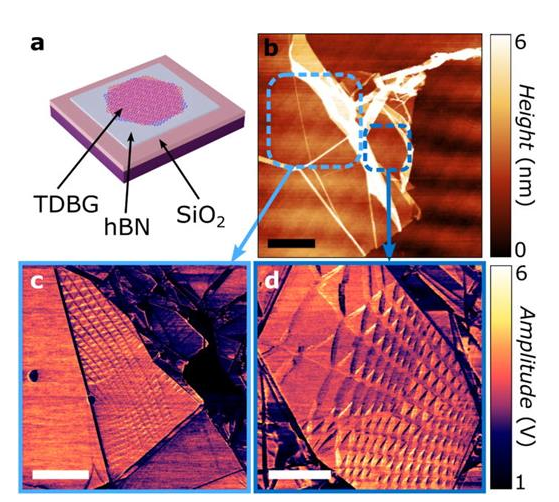
Two-dimensional (2D) materials have attracted significant interest due to their tunable physical properties when stacked into homo- and heterostructures. Twisting adjacent layers introduces moiré patterns that strongly influence the material’s electronic and thermal behavior. In twisted graphene systems, the twist angle critically alters phonon transport, leading to reduced thermal conductivity compared to Bernal-stacked configurations. However, experimental investigations into thermal transport in twisted structures remain limited. Here, we study the local thermal properties of low-angle (⁠ ⁠) twisted double bilayer graphene using scanning thermal microscopy. We find an increase in thermal resistance of  KW−1 compared to untwisted bilayers, attributed to changes in both intrinsic thermal conductivity and the tip–sample interface. Analytical modeling shows that such variations may be attributed to intrinsic conductivity changes or modifications of the tip–sample interface resistance, or a combination of both. Our study highlights how twist alters the overall thermal resistance network in graphene heterostructures, providing direct nanoscale evidence that moiré engineering impacts multiple pathways of heat dissipation. These insights advance understanding of thermal transport in twisted 2D systems and open avenues for thermal management in twistronic devices.

Thermal transport mapping in twisted double bilayer graphene Read More »

Probing the Flat-Band Limit of the Superconducting Proximity Effect in Twisted Bilayer Graphene Josephson Junctions

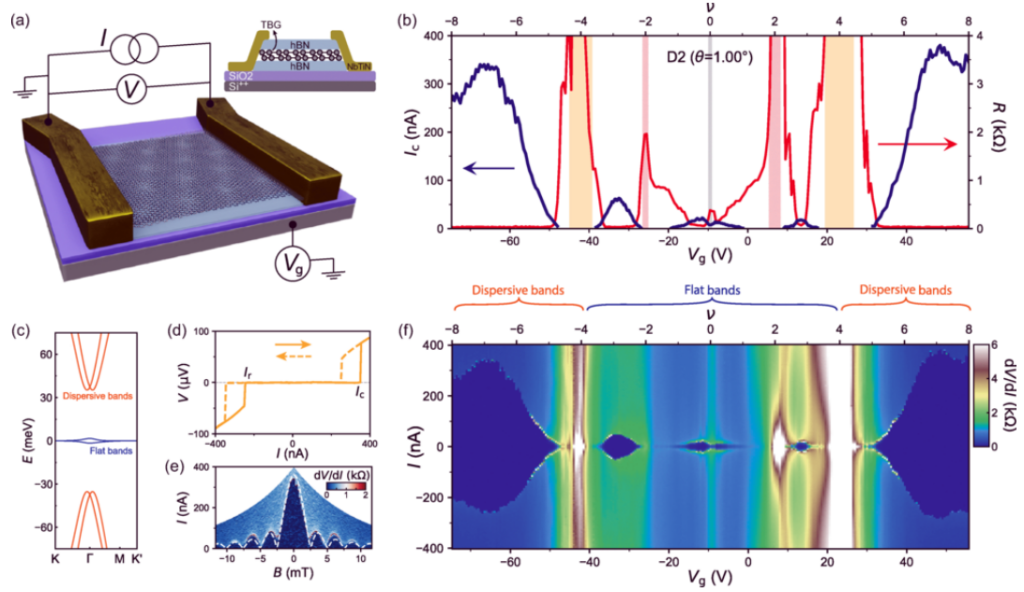
While extensively studied in normal metals, semimetals, and semiconductors, the superconducting (SC) proximity effect remains elusive in the emerging field of flat-band systems. In this study, we probe proximity-induced superconductivity in Josephson junctions (JJs) formed between superconducting NbTiN electrodes and twisted bilayer graphene (TBG) weak links. Here, the TBG acts as a highly tunable topological flat-band system, which, due to its twist-angle-dependent bandwidth, allows us to probe the SC proximity effect at the crossover from the dispersive to the flat-band limit. Contrary to our original expectations, we find that the induced superconductivity remains strong even in the flat-band limit and gives rise to broad, dome-shaped SC regions, in the filling-dependent phase diagram. In addition, we find that, unlike in conventional JJs, the critical current 𝐼𝑐 strongly deviates from a scaling with the normal state conductance 𝐺𝑁. We attribute these findings to the onset of strong electron interactions, which can give rise to an excess critical current. By also studying the dependence of 𝐼𝑐 on the filling and twist angle across multiple samples, we further uncover the importance of quantum geometric terms as well as multiband pairing mechanisms in describing the induced superconductivity in the TBG flat bands as their bandwidth decreases. To the best of our knowledge, our results present the first detailed study of the SC proximity effect in the flat-band limit and shed new light on the mechanisms that drive the formation of SC domes in flat-band systems.

Probing the Flat-Band Limit of the Superconducting Proximity Effect in Twisted Bilayer Graphene Josephson Junctions Read More »

Taxonomy of defects in semi-dry transferred CVD graphene

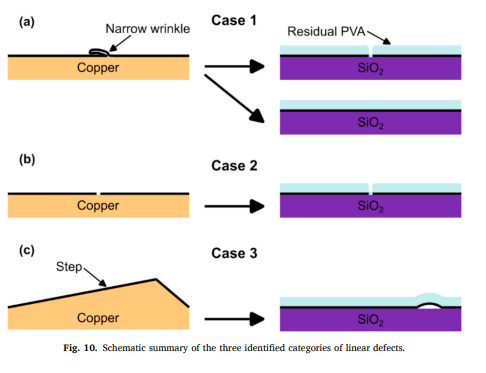
Post-transfer in-depth morphological characterization of graphene grown by chemical vapor deposition (CVD) is of great importance to evaluate the quality and to understand the origin of defects in the transferred sheets. Herein, a semi-dry transfer technique is used to peel off millimeter-sized CVD graphene flakes from polycrystalline copper foils and transfer them onto SiO2/Si substrates. We take advantage of the unique feature of this semi-dry process: it preserves the copper substrate, enabling location-specific morphological comparisons between graphene and copper at various stages of the transfer. Thanks to a combination of morphological characterization techniques, this leads to trace and elucidate the origin of various post-transfer graphene defects (cracks, wrinkles, holes, tears). Specifically, thermally induced wrinkles are shown to evolve into nanoscale cracks, while copper surface steps lead to folds. Furthermore, we find that the macroscale topography of the copper foil also plays a critical role in defect formation. This work provides guidelines on how to correctly interpret the post-transfer morphology of graphene films on relevant substrates and how to properly assess their quality. This contributes to the optimization of both the graphene CVD growth and transfer processes for future applications.

Taxonomy of defects in semi-dry transferred CVD graphene Read More »

Upper limit of spin relaxation in suspended graphene

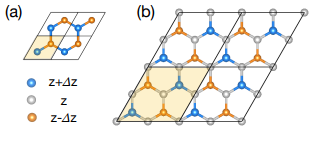
We use a combination of molecular dynamics and quantum transport simulations to investigate the upper limit of spin transport in suspended graphene. We find that thermally-induced atomic-scale corrugations are the dominant factor, limiting spin lifetimes to 10 ns by inducing a strongly-varying local spin–orbit coupling. These extremely short-range corrugations appear even when the height profile appears to be smooth, suggesting they may be present in any graphene device. We discuss our results in the context of experiments, and briefly consider approaches to suppress these short-range corrugations and further enhance spin lifetimes in graphene-based spin devices.

Upper limit of spin relaxation in suspended graphene Read More »

Disorder-Induced Delocalization in Magic-Angle Twisted Bilayer Graphene

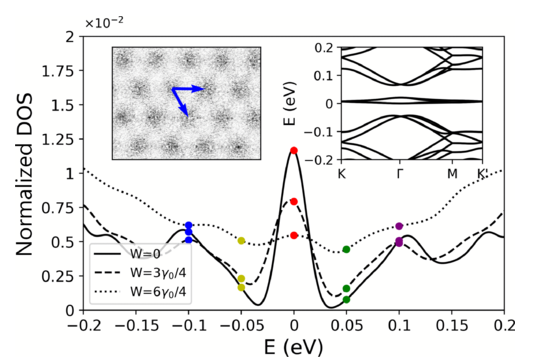
Flat bands in moiré systems are exciting new playgrounds for the generation and study of exotic many-body physics phenomena in low-dimensional materials. Such physics is attributed to the vanishing kinetic energy and strong spatial localization of the flat-band states. Here, we use numerical simulations to examine the electronic transport properties of such flat bands in magic-angle twisted bilayer graphene in the presence of disorder. We find that while a conventional downscaling of the mean free path with increasing disorder strength occurs at higher energies, in the flat bands the mean free path can actually increase with increasing disorder strength. This phenomenon is also captured by the disorder-dependent quantum metric, which is directly linked to the ground state localization. This disorder-induced delocalization suggests that weak disorder may have a strong impact on the exotic physics of magic-angle bilayer graphene and other related moiré systems.

Disorder-Induced Delocalization in Magic-Angle Twisted Bilayer Graphene Read More »