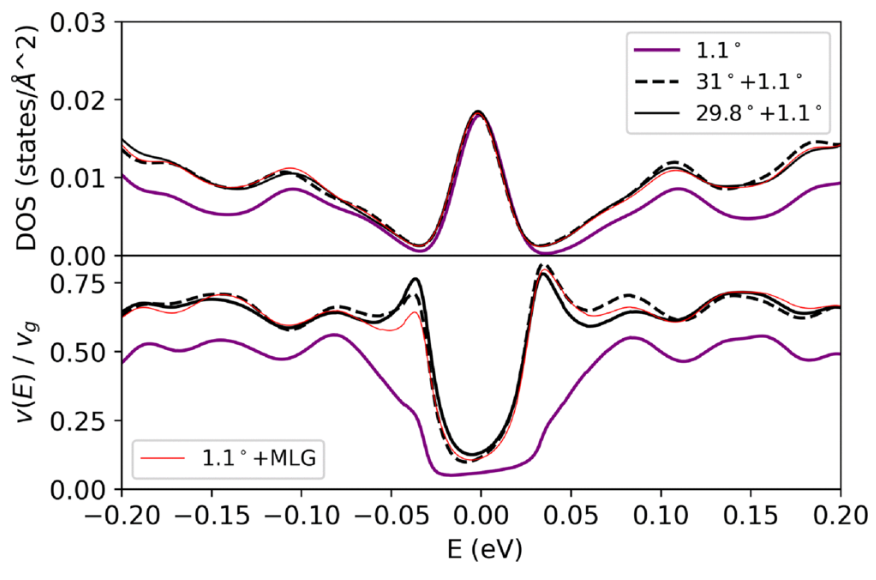
We present a numerical study of three-layer graphene heterostructures in which the layers are twisted by the magic angle (∼1.1∘) or by ∼30∘ to form a graphene quasicrystal. The heterostacks are described using realistic structural relaxations and tight-binding Hamiltonians, and their transport properties are computed for both pristine and disordered systems containing up to ∼8 million atoms. Owing to the weak interlayer coupling, we resolve the hybridization between magic-angle flat bands and quasicrystalline states, which are modified in distinct ways across low- and high-energy windows, revealing a different hybrid electronic regime to explore.
Proximity effects between a graphene quasicrystal and magic-angle twisted bilayer graphene