Aurélie Féré

Impact of the angular alignment on the crystal field and intrinsic doping of bilayer graphene/BN heterostructures

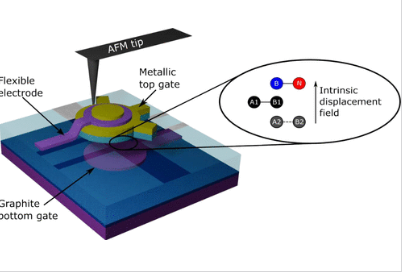
The ability to tune the energy gap in bilayer graphene makes it the perfect playground for the study of the effects of internal electric fields, such as the crystalline field, which are developed when other layered materials are deposited on top of it. Here, we introduce a novel device architecture allowing simultaneous control over the applied displacement field and the crystalline alignment between two materials. Our experimental and numerical results confirm that the crystal field and electrostatic doping due to the interface reflect the 120° symmetry of the bilayer graphene/BN heterostructure and are highly affected by the commensurate state. These results provide unique insight into the role of twist angle in the development of internal crystal fields and intrinsic electrostatic doping in heterostructures. Our results highlight the importance of layer alignment, beyond the existence of a moiré superlattice, to understand the intrinsic properties of a heterostructure.
Impact of the angular alignment on the crystal field and intrinsic doping of bilayer graphene/BN heterostructures Read More »

International Symposium on Moiré Systems, Quantum Twisting Microscopes, and Beyond

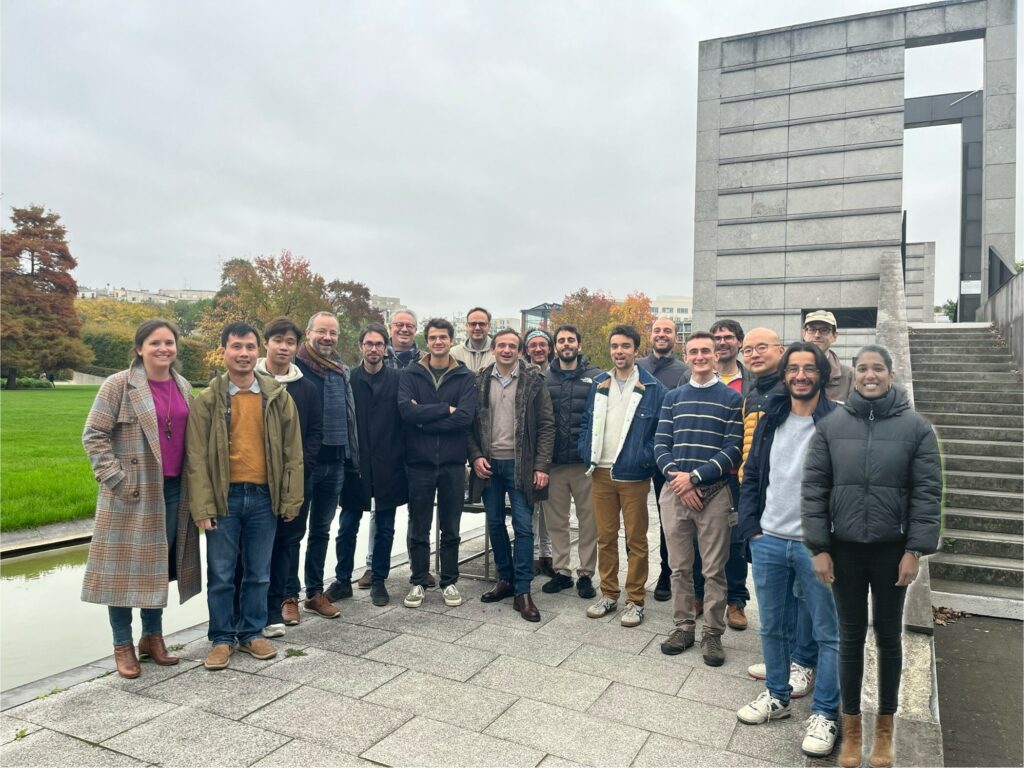
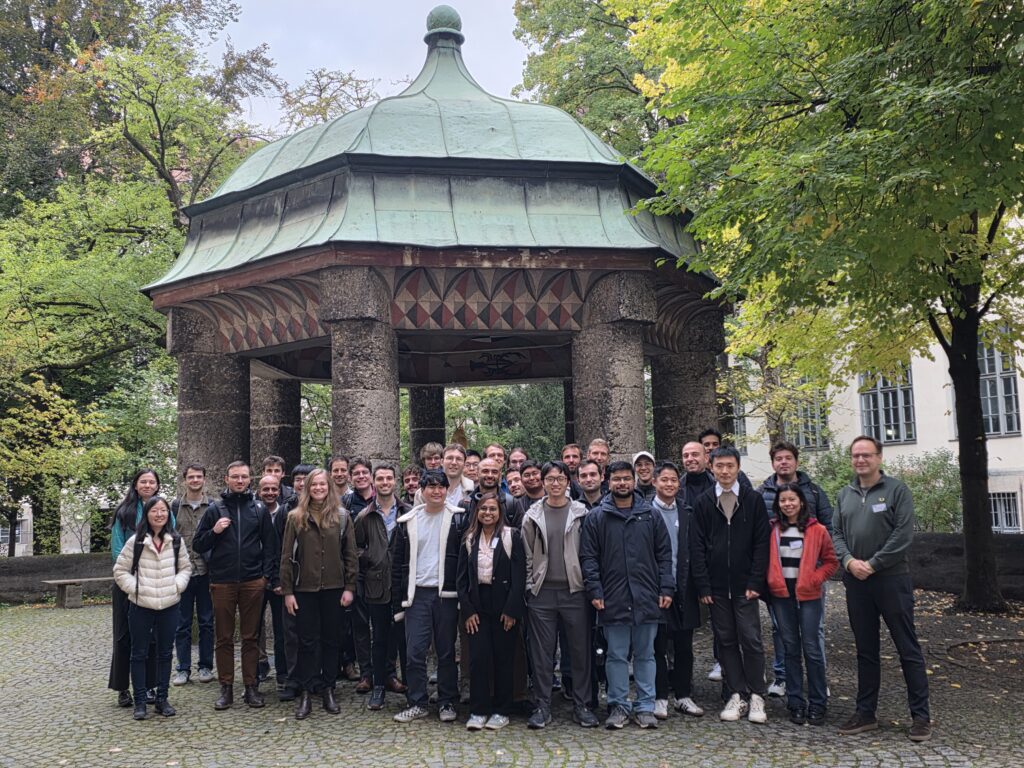
Dima Efetov organized the international symposium International Symposium on Moiré Systems, Quantum Twisting Microscopes, and Beyond on 9 and 10 October 2025. Raphaël Ayache from CEA participated in this symposium, which brought together leading young researchers working on moiré materials, quantum microscopy, and related emerging topics.

International Symposium on Moiré Systems, Quantum Twisting Microscopes, and Beyond Read More »

Electron collision in a two-path graphene interferometer

The collision of two electrons at a beam splitter provides a method for studying their coherence and indistinguishability. Its realization requires the on-demand generation and synchronization of single electrons. In this work, we demonstrate the coherent collision of single electrons, generated by voltage pulses, in a graphene Mach-Zehnder interferometer. By measuring shot noise resulting from the collisions, we unveil fundamental characteristics of colliding electrons, highlighting the complementarity between the indistinguishable and distinguishable parts of their wave functions. The former is manifested through fermionic Hong-Ou-Mandel destructive interference, whereas the latter is discerned through double-winding Aharonov-Bohm interference in the noise. The interference visibilities of around 60% enable comprehensive quantum state tomography. Our findings may place coherent operations involving flying qubits within reach in graphene.

Electron collision in a two-path graphene interferometer Read More »

FLATS at the Fête de la Science at Orsay on 6th of October 2024

This year again, on the occasion of the Fête de la Science, the CNRS offered unusual visits, immersions in the heart of scientific research in small groups. These meetings were intended to be intimate, interactive and integrating an exceptional character. In this context, FLATS was presented by Maelle Kepfer. This event has gathered more than 200 participants.

FLATS at the Fête de la Science at Orsay on 6th of October 2024 Read More »

Infrared single-photon detection with superconducting magic-angle twisted bilayer graphene

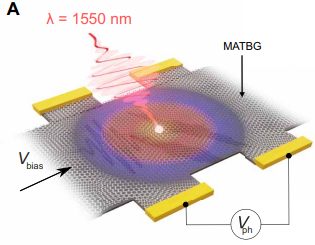
The moiré superconductor magic-angle twisted bilayer graphene (MATBG) shows exceptional properties, with an electron (hole) ensemble of only ~1011 carriers per square centimeter, which is five orders of magnitude lower than traditional superconductors (SCs). This results in an ultralow electronic heat capacity and a large kinetic inductance of this truly two-dimensional SC, providing record-breaking parameters for quantum sensing applications, specifically thermal sensing and single-photon detection. To fully exploit these unique superconducting properties for quantum sensing, here, we demonstrate a proof-of-principle experiment to detect single near-infrared photons by voltage biasing an MATBG device near its superconducting phase transition.We observe complete destruction of the SC state upon absorption of a single infrared photon even in a 16–square micrometer device, showcasing exceptional sensitivity. Our work offers insights into the MATBG-photon interaction and demonstrates pathways to use moiré superconductors as an exciting platform for revolutionary quantum devices and sensors.

Infrared single-photon detection with superconducting magic-angle twisted bilayer graphene Read More »

Identifying and abating copper foil impurities to optimize graphene growth

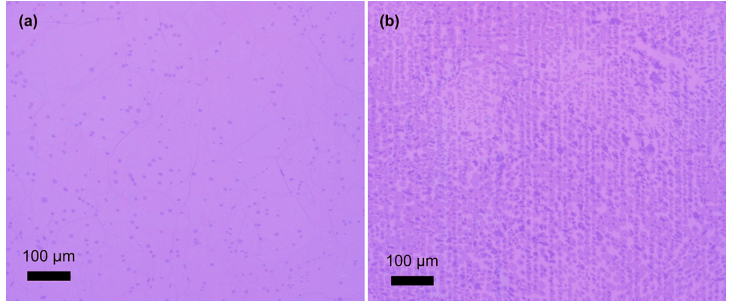
Copper foil impurities are hampering scalable production of high-quality graphene by chemical vapor deposition (CVD). Here, we conduct a thorough study on the origin of these unavoidable contaminations at the surface of copper after the CVD process. We identify two distinct origins for the impurities. The first type is intrinsic impurities, originating from the manufacturing process of the copper foils, already present at the surface before any high-temperature treatment, or buried into the bulk of copper foils. The buried impurities diffuse towards the copper surface during high-temperature treatment and precipitate. The second source is external: silica contamination arising from the quartz tube that also precipitate on copper. The problem of the extrinsic silica contamination is readily solved upon using an adequate confinement the copper foil samples. The intrinsic impurities are much more difficult to remove since they appear spread in the whole foil. Nevertheless, electropolishing proves particularly efficient in drastically reducing the issue.

Identifying and abating copper foil impurities to optimize graphene growth Read More »