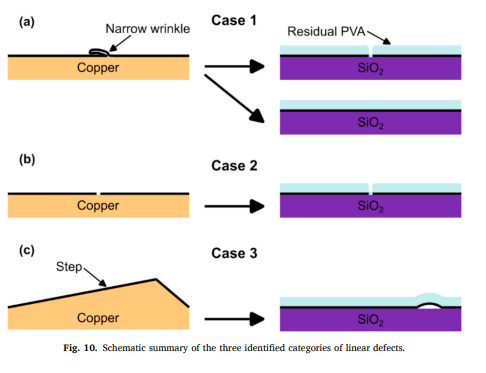
Post-transfer in-depth morphological characterization of graphene grown by chemical vapor deposition (CVD) is of great importance to evaluate the quality and to understand the origin of defects in the transferred sheets. Herein, a semi-dry transfer technique is used to peel off millimeter-sized CVD graphene flakes from polycrystalline copper foils and transfer them onto SiO2/Si substrates. We take advantage of the unique feature of this semi-dry process: it preserves the copper substrate, enabling location-specific morphological comparisons between graphene and copper at various stages of the transfer. Thanks to a combination of morphological characterization techniques, this leads to trace and elucidate the origin of various post-transfer graphene defects (cracks, wrinkles, holes, tears). Specifically, thermally induced wrinkles are shown to evolve into nanoscale cracks, while copper surface steps lead to folds. Furthermore, we find that the macroscale topography of the copper foil also plays a critical role in defect formation. This work provides guidelines on how to correctly interpret the post-transfer morphology of graphene films on relevant substrates and how to properly assess their quality. This contributes to the optimization of both the graphene CVD growth and transfer processes for future applications.
Taxonomy of defects in semi-dry transferred CVD graphene