Publications

Recursive Green’s functions optimized for atomistic modelling of large superlattice‑based devices

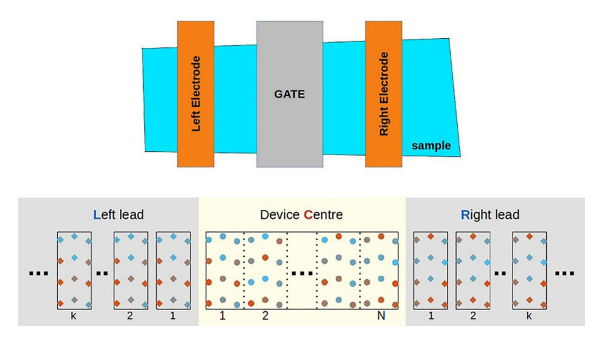
The Green’s function method is recognized to be a very powerful tool for modelling quantum transport in nanoscale electronic devices. As atomistic calculations are generally expensive, numerical methods and related algorithms have been developed accordingly to optimize their computation cost. In particular, recursive techniques have been efciently applied within the Green’s function calculation approach. Recently, with the discovery of Moiré materials, several attractive superlattices have been explored using these recursive Green’s function techniques. However, numerical difculty issues were reported as most of these superlattices have relatively large supercells, and consequently a huge number of atoms to be considered. In this article, improvements to solve these issues are proposed in order to keep optimizing the recursive Green’s function calculations. These improvements make the electronic structure calculations feasible and efcient in modelling large superlattice-based devices. As an illustrative example, twisted bilayer graphene superlattices are computed and presented to demonstrate the efciency of the method.
Recursive Green’s functions optimized for atomistic modelling of large superlattice‑based devices Read More »

Non-identical moiré twins in bilayer graphene

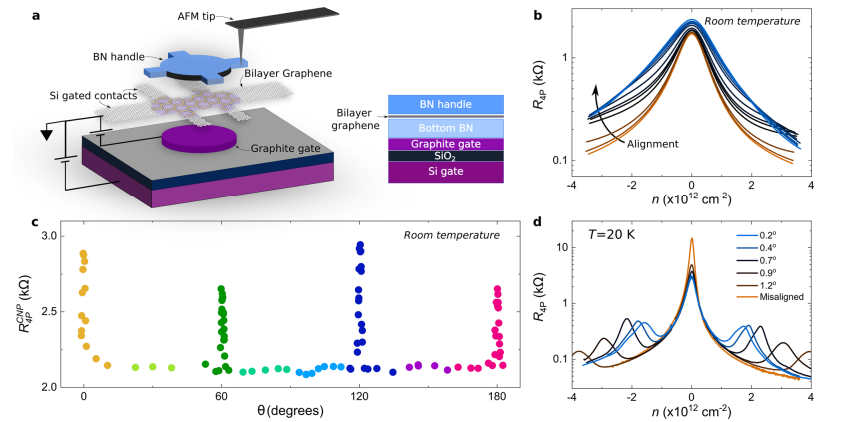
The superlattice obtained by aligning a monolayer graphene and boron nitride (BN) inherits from the hexagonal lattice a sixty degrees periodicity with the layer alignment. It implies that, in principle, the properties of the heterostructure must be identical for 0° and 60° of layer alignment. Here, we demonstrate, using dynamically rotatable van der Waals heterostructures, that the moiré superlattice formed in a bilayer graphene/BN has different electronic properties at 0° and 60° of alignment. Although the existence of these non-identical moiré twins is explained by different relaxation of the atomic structures for each alignment, the origin of the observed valley Hall effect remains to be explained. A simple Berry curvature argument is not sufficient to explain the 120° periodicity of this observation. Our results highlight the complexity of the interplay between mechanical and electronic properties in moiré structures and the importance of taking into account atomic structure relaxation to understand their electronic properties.

Non-identical moiré twins in bilayer graphene Read More »